A Database Management System (DBMS) is a software used to store, manage, and retrieve data in an organized way. In today’s digital world, data plays a very important role, and DBMS helps in handling large amounts of data efficiently.
From banks to schools, hospitals to e-commerce websites, almost every organization uses DBMS to manage their data. It ensures that data is stored securely, accessed easily, and maintained properly.
🔍 What is DBMS?
A Database Management System (DBMS) is a program that allows users to create, manage, and manipulate databases. A database is a collection of related data organized in a structured format.
Simple Definition:
DBMS = Software to manage databases
Example:
- Student records in a school
- Customer data in a bank
- Product details in an online store
All these are managed using DBMS.
🧩 Components of DBMS
A DBMS consists of several components:
1. Database
A collection of organized data.
2. DBMS Software
The program used to manage the database.
3. Users
People who interact with the database (admin, developers, users).
4. Hardware
Physical devices like computers and storage systems.
5. Procedures
Rules and instructions for using the database.
⚙️ Functions of DBMS
DBMS performs many important functions:
1. Data Storage
Stores large amounts of data in an organized way.
2. Data Retrieval
Allows users to search and retrieve data quickly.
3. Data Manipulation
Users can insert, update, and delete data.
4. Data Security
Protects data from unauthorized access.
5. Data Integrity
Ensures data accuracy and consistency.
6. Backup and Recovery
Provides backup and restores data in case of failure.
📊 Types of DBMS
DBMS is classified into different types:
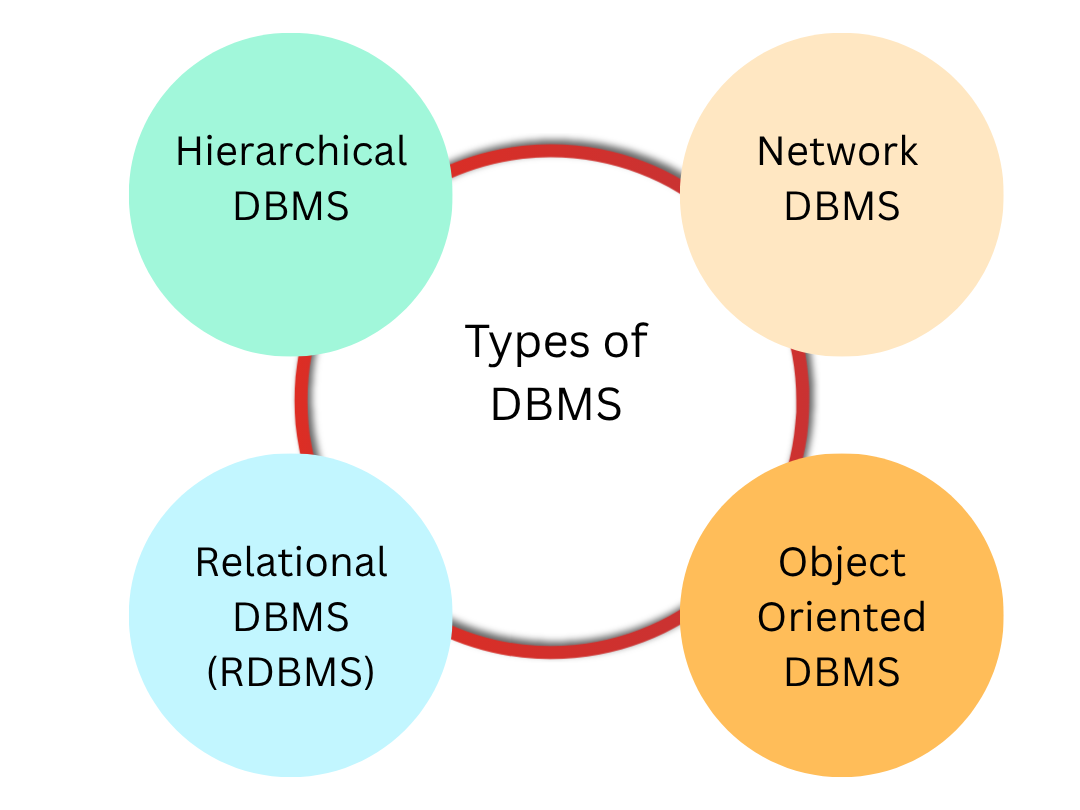
1. Hierarchical DBMS
- Data is organized in tree structure
- Parent-child relationship
Example:
- XML data
2. Network DBMS
- Data is connected like a network
- Multiple relationships
3. Relational DBMS (RDBMS)
- Data is stored in tables (rows and columns)
- Most widely used type
Examples:
4. Object-Oriented DBMS
- Data stored as objects
- Used in advanced applications
🗄️ Key Concepts in DBMS
Table
A collection of data in rows and columns.
Record
A single row in a table.
Field
A column in a table.
Primary Key
Unique identifier for each record.
Foreign Key
Links between tables.
🧠 Advantages of DBMS
DBMS provides many benefits:
1. Data Organization
Stores data in structured format.
2. Data Security
Protects sensitive information.
3. Data Sharing
Multiple users can access data.
4. Data Consistency
Reduces data duplication.
5. Backup and Recovery
Prevents data loss.
6. Easy Access
Quick retrieval of data.
❌ Disadvantages of DBMS
Some limitations include:
- High cost
- Complex setup
- Requires skilled professionals
- Performance issues with large data
🌐 Real-Life Applications of DBMS
DBMS is used in many industries:
Banking
Stores customer and transaction data.
Education
Manages student records and results.
Healthcare
Stores patient data and medical history.
E-commerce
Manages product and customer data.
Social Media
Stores user profiles and posts.
🔐 Security in DBMS
DBMS provides security through:
- User authentication
- Access control
- Data encryption
This ensures that only authorized users can access data.
🆚Database Management System (DBMS) vs File System
| DBMS | File System |
|---|---|
| Organized data | Unstructured data |
| High security | Low security |
| Easy data access | Difficult access |
| Supports multiple users | Limited users |
📈 Importance of DBMS
DBMS is important because:
- Manages large data efficiently
- Improves data accuracy
- Supports decision-making
- Enhances data security
- Reduces redundancy
🚀 Future of DBMS
DBMS is evolving with new technologies like:
- Cloud databases
- Big data
- Artificial Intelligence
Modern databases are becoming faster, more secure, and scalable.
📌 Conclusion
A Database Management System (DBMS) is essential for managing and organizing data in today’s digital world. It helps store, retrieve, and protect data efficiently. With features like data security, backup, and easy access, DBMS is widely used in various industries. Understanding DBMS basics is important for students and professionals in the field of information technology.